Painted in Defiance: How Blue Became Britain's Most Politically Charged Colour
Colour has always been political. From the red of revolutionary banners to the suffragette's deliberate deployment of purple and green, pigment carries ideology in ways that language sometimes cannot. Yet one colour has emerged with quiet insistence across British activist art over the past decade — blue, in all its contradictory, oceanic complexity.
It is not the blue of establishment conservatism, nor the genteel cerulean of a country watercolour. The blue appearing in protest murals on Manchester's Northern Quarter, in installation art at Bristol's independent spaces, and in the placards of climate demonstrators outside Parliament is something altogether more unsettling. It is the blue of cold water rising, of bruised skin, of ink spilled across a document that should never have been signed.
A Colour With Ancient Radical Credentials
To understand why blue has accumulated such potent meaning in contemporary British activist culture, it helps to travel backwards. The Picts — those Celtic-speaking peoples who resisted Roman imperial expansion across what is now Scotland — famously adorned their bodies in woad, a plant-derived blue pigment that became, in the Roman imagination at least, the very symbol of northern intractability and refusal.
This association between blue and resistance was not merely a classical invention. Throughout the medieval period, blue dyes were expensive and difficult to produce, making the colour simultaneously a marker of elite privilege and, when worn by those who had no business wearing it, a gesture of subversion. The symbolic freight of the colour was contested from the outset.
Dr Miriam Okafor, a cultural historian who has written extensively on colour symbolism in British protest movements, argues that this historical complexity is precisely what makes blue so useful to contemporary artists. "Blue is never settled," she explains. "It belongs to the sky and to the state simultaneously. It is the colour of police uniforms and the colour of the sea that climate change is destroying. Artists working with blue are always working with that tension, whether they acknowledge it consciously or not."
Woad, Water, and Wrath: Blue in the Gallery
Walk into almost any independently curated exhibition engaging with ecological or social justice themes in Britain today, and you will encounter blue in some form. Sometimes it is the deep indigo of Yinka Shonibare's fabric works, invoking colonial trade routes across the Atlantic. Sometimes it is the pale, clinical blue of institutional critique — the colour of NHS corridors, of government letterheads, of forms that deny people the support they require.
London-based artist collective Meridian Blue — whose name is itself a provocation, reclaiming the colour from its cartographic associations with imperial measurement — have made the hue the explicit subject of their practice. Their 2023 installation Tide Table, which toured several UK independent arts centres, consisted of thousands of strips of blue-dyed fabric suspended from gallery ceilings at varying heights, each strip representing a recorded instance of a climate-related displacement event worldwide.
"We chose blue because it refuses to be comfortable," says collective member Priya Anand. "When you stand beneath Tide Table, you are standing beneath water. The ceiling becomes the sea floor. That is not a metaphor we invented — it is a metaphor that reality is forcing upon us."
The Anarchist Thread
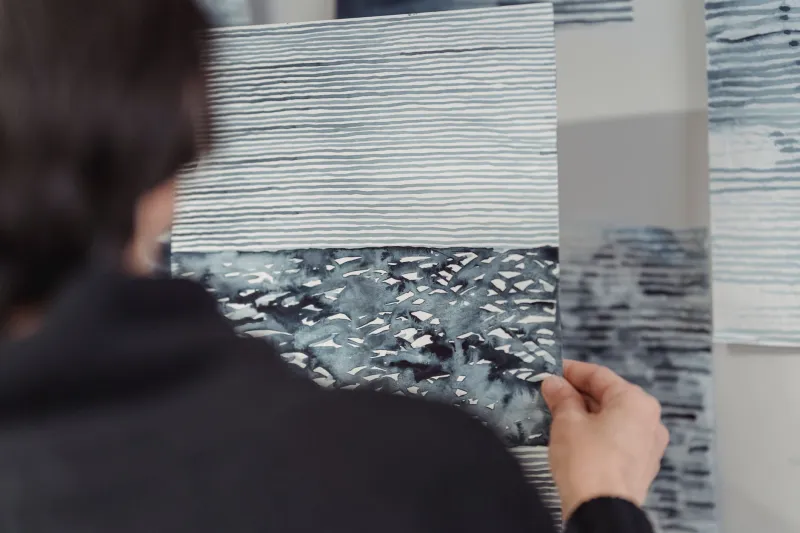
Beyond ecological activism, blue carries a more explicitly political lineage within British radical culture. The blue-black of anarchist aesthetics — distinct from the pure black of nihilism — has appeared on zines, screenprinted posters, and independent publications since at least the 1970s. This particular shade, sometimes described as "midnight" or "ink" blue, was partly a practical choice: it reproduced more clearly than pure black on photocopied pamphlets and was less likely to attract the attention of authorities scanning for overtly provocative imagery.
Over time, it became a recognisable visual shorthand within certain communities. Independent arts centres, many of which emerged from or maintained sympathetic relationships with squatter culture and community organising, absorbed this aesthetic into their visual identities without always announcing the connection explicitly.
Curator and writer Seamus Donnelly, who has documented the visual culture of British independent arts spaces since the 1990s, notes that many of the country's most significant grassroots venues share a striking tendency towards blue in their printed materials and signage. "It is rarely accidental," he suggests. "These spaces know their history. The blue is a form of institutional memory, a way of signalling affiliation without having to spell it out."
Climate Blue and the Question of Hope
Perhaps the most significant development in blue's symbolic life within British activist art is its recent association with climate grief and environmental justice movements. Extinction Rebellion's use of blue in certain campaigns, the proliferation of ocean-themed installation art, and the emergence of what some critics have begun calling "ecological melancholy" as a distinct aesthetic mode have all contributed to a cultural moment in which blue functions simultaneously as an expression of mourning and of stubborn, battered hope.
This duality is not without its critics. Some disabled artists and critics from marginalised communities have raised important questions about whose grief is being centred in predominantly white-led environmental art movements, and whether the aestheticisation of ecological crisis risks producing beautiful objects that allow audiences to feel moved without being moved to act.
These are vital challenges, and they are being taken seriously within the more self-aware corners of the British arts ecology. The most interesting work being made with blue at present is that which holds the colour's contradictions in productive tension — acknowledging both its radical heritage and its capacity to be recuperated by institutions seeking the appearance of criticality without its substance.
What Colour Does Next
Colour in art has never been innocent, and blue is perhaps the least innocent of all. Its associations are too multiple, its history too layered, for it to function as mere decoration. In the hands of British artists working at the intersection of aesthetics and politics, it remains one of the most generative and genuinely unsettling tools available.
Whether daubed on a protest banner outside a council building, suspended in strips from an arts centre ceiling, or rendered in obsessive detail in a painting that asks uncomfortable questions about who controls our coastlines and our institutions, blue continues to earn its radical credentials. It is a colour that refuses to resolve — and in a cultural moment that demands easy answers, that refusal is itself a form of resistance.