Three Centuries of Creative Defiance: The Enduring Soul of Britain's Oldest Arts Centre
A Building That Refused to Stand Still
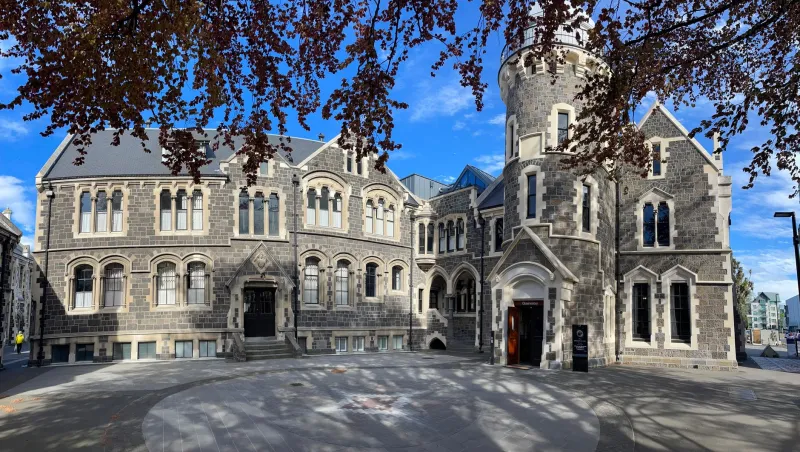
There is something quietly extraordinary about standing in the Bluecoat's cobbled courtyard on a winter afternoon, the Georgian façade rising above you in warm red brick, the city's noise filtering through the archway from Hanover Street. It does not look like a place of revolution. And yet, for three centuries, that is precisely what it has been.
Completed in 1717 as a charity school for the children of Liverpool's poor, the Bluecoat building predates the very concept of the arts centre by well over a hundred years. Its original purpose was philanthropic and firmly institutional — a place where discipline and doctrine shaped young lives. That it would eventually become a crucible for avant-garde thought, radical performance, and artistic dissent could not have been foreseen by its founders. And perhaps that tension — between the building's sober origins and its restless present — is precisely what gives it such peculiar creative energy.
By the early twentieth century, the school had relocated, and the building entered a period of reinvention. Artists, craftspeople, and cultural agitators began to occupy its rooms. In 1907, a group of creative practitioners formed the Sandon Studios Society within its walls, establishing the Bluecoat as a locus for serious artistic exchange. Just four years later, in 1911, the building hosted one of the most significant exhibitions in British art history: the Post-Impressionist show that brought the work of Cézanne, Van Gogh, and Gauguin to a northern audience that had scarcely encountered such visual audacity. Liverpool saw it before most of England had even heard of it.
The Radical Inheritance
To understand the Bluecoat's cultural significance, one must resist the temptation to treat its history as a series of isolated milestones. The thread connecting the 1911 Post-Impressionist exhibition to today's artist residencies is not coincidental — it is constitutive. Each generation of practitioners who has worked within these walls has inherited and extended a particular disposition: the belief that art must challenge, unsettle, and ultimately transform the conditions in which it is made and received.
Throughout the mid-twentieth century, the Bluecoat became increasingly central to Liverpool's identity as a city of cultural ambition. The building survived wartime bombing that devastated much of the surrounding city centre, a fact that many who work here today regard as something more than fortunate accident. Its survival felt, and continues to feel, purposeful.
The formal establishment of the Bluecoat as an arts centre in the post-war period coincided with a broader national reckoning about the role of culture in public life. The Arts Council had been founded. The welfare state was being constructed. There was, briefly, a genuine political will to place creative experience at the heart of civic society. The Bluecoat stepped into that moment with characteristic confidence, expanding its programming, opening its galleries, and deepening its commitment to artists who were doing work that made comfortable audiences uncomfortable.
What Provocation Means in 2024
The word 'provocation' risks becoming a cliché in arts discourse — deployed so frequently that it loses its edge. At the Bluecoat, however, provocation has always carried specific weight. It is not merely about controversy for its own sake, but about the deliberate disruption of settled assumptions: about who art is for, whose stories it tells, and what kinds of beauty or difficulty it is permitted to contain.
For the artists currently working within the Bluecoat's residency programme, this inheritance is both a resource and a responsibility. Textile and installation artist Amara Osei-Bonsu, whose work explores the material legacies of colonial trade routes through West African cloth and Liverpool's own mercantile history, describes the building's atmosphere as 'charged in a way I don't experience anywhere else. You're aware that people have been making difficult work here for a very long time. It raises the stakes.'
That sense of raised stakes feels particularly urgent given the current state of arts funding in Britain. Since 2010, local authority spending on culture has fallen by more than 40 per cent in real terms. Dozens of regional arts organisations have closed or significantly contracted. In this environment, the Bluecoat's longevity is not simply a matter of historical prestige — it is a form of institutional argument. It demonstrates, empirically, that sustained investment in a place of creative encounter generates cultural returns that accumulate across generations.
Cultural commentator and Liverpool-based writer Diane Acheampong puts it plainly: 'The Bluecoat isn't just a building or a programme — it's proof of concept. It proves that if you commit to a place and give artists genuine freedom within it, something irreplaceable grows. The tragedy of defunding culture is that you don't notice what you've lost until it's been gone for fifty years.'
Beyond the White Cube
One of the most significant shifts in the Bluecoat's recent history has been a determined expansion of what its public-facing programme looks like. Under the stewardship of successive directors committed to genuine inclusivity — not merely its rhetoric — the centre has worked to dismantle the invisible barriers that have historically made contemporary art spaces feel inaccessible to working-class communities, to people of colour, to those with disabilities, and to young people without cultural capital.
This has meant commissioning artists whose practices begin from lived experience rather than institutional training. It has meant programming that takes place in the courtyard, in the café, in community spaces across Merseyside, rather than exclusively within gallery walls. And it has meant having honest, sometimes difficult conversations about the history of the building itself — including its proximity, both geographic and economic, to the transatlantic slave trade that made Liverpool wealthy in the eighteenth century.
These conversations are not comfortable. They are not intended to be. But they represent the most authentic expression of the Bluecoat's founding instinct: that a place of genuine cultural encounter must be willing to examine itself as rigorously as it examines the world beyond its doors.
Why It Still Matters
In an era of digital saturation, when art can be streamed, shared, and algorithmically recommended, the question of why a physical arts centre matters is worth addressing directly. The answer the Bluecoat has always offered — through its programming, its architecture, and its ethos — is that embodied encounter with art is irreplaceable. That standing in a room with a work that unsettles you, in a building that carries three centuries of creative memory, produces a quality of experience that no screen can replicate.
The Bluecoat turns 307 this year. It has outlasted schools, wars, economic collapses, and successive waves of cultural fashion. It has done so not by accommodating the prevailing winds, but by maintaining a commitment to the difficult, the necessary, and the genuinely new. In the current climate, that commitment is not heritage. It is resistance.
And resistance, as the building has always understood, is where art begins.