Turn It Up: Why Sound Has Become Contemporary Britain's Most Contested Art Form
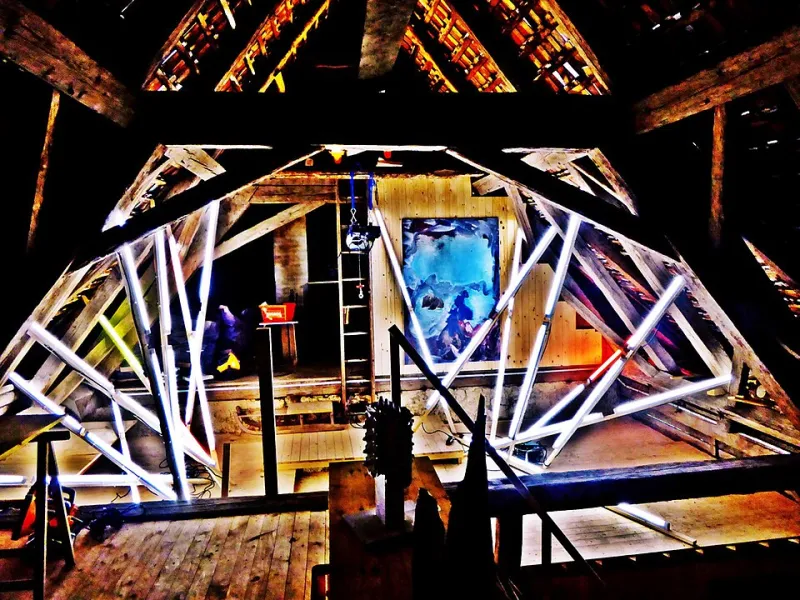
Photo: Pedro Meier, CC BY-SA 4.0, via Wikimedia Commons
Across Britain's independent arts centres, something is getting louder — and more deliberately, more politically loud. Sound art, experimental audio performance, and what practitioners are calling 'sonic disruption' have moved from the margins of contemporary programming to its increasingly assertive centre, challenging long-held assumptions about what constitutes culturally acceptable noise.
This is not simply an aesthetic development. It is, its practitioners argue, a fundamentally political one. And understanding why requires examining not just what these venues are programming, but what they are pushing back against.
The Hierarchy of Acceptable Sound
British cultural life has always operated according to a highly stratified sonic order. At its apex sit forms whose respectability is encoded in their very quietness: the hushed gallery, the attentive concert hall, the reverential museum. These spaces demand silence from their visitors — not merely as a practical courtesy but as a demonstration of cultural competence. To be quiet in the right places is to signal that you know the rules, that you belong to the tradition, that you understand what is at stake.
This hierarchy of acceptable sound maps onto class with uncomfortable precision. The forms that have historically commanded the highest cultural prestige — orchestral music, opera, the visual arts in their most contemplative register — are forms that require and reward the trained capacity for silence. The forms associated with working-class and minority ethnic communities — sound systems, brass bands, communal singing, music at volume — have been persistently coded as noise rather than culture, disruption rather than expression.
When arts centres programme sound art that is genuinely, uncomfortably loud, they are not simply making an aesthetic choice. They are intervening in this hierarchy. They are insisting that the sonic cultures excluded from the category of 'legitimate art' have always been legitimate, and that the category itself requires interrogation.
The Politics of the Frequency
Sound artists working in UK independent venues are increasingly explicit about this political dimension. Practitioners such as Ain Bailey, whose work explores the relationship between sound, identity, and space, have articulated a practice in which audio is deployed not as decoration or accompaniment but as a primary medium for political thought.
Bailey's sound works, which have appeared in venues across the country, use frequency, volume, and spatial distribution to create experiences that cannot be neutralised by the gallery's conventional mechanisms of aesthetic distance. You cannot stand back from a sound that occupies your body. You cannot adopt the contemplative remove of the ideal gallery visitor when the work is physically present in your chest cavity, your eardrums, your nervous system.
This embodied quality is central to sound art's political potential. The visual arts, however challenging their content, can be received from a position of controlled remove. Sound refuses this. It enters without permission. It makes the audience porous in a way that visual art, for all its provocations, rarely achieves.
Silence as Its Own Provocation
It would be a mistake to assume that the sonic politics of British arts centres are exclusively about volume. Silence — deployed strategically, contextually, and with full awareness of its own ambiguity — is equally potent as a tool of cultural disruption.
Several venues have experimented with programming that inverts the conventional relationship between silence and cultural authority. Rather than demanding silence as a condition of cultural participation, these programmes use enforced or invited silence as a way of defamiliarising the audience's relationship to sound itself. When silence is the artistic proposition rather than the institutional requirement, it becomes available for examination rather than simply compliance.
The Scottish composer and sound artist Hanna Tuulikki has worked extensively in this territory, creating performances in which the boundaries between ambient sound, environmental noise, and deliberate musical gesture are systematically dissolved. Audiences accustomed to the clear demarcations of the concert hall find themselves uncertain about what is 'the work' and what is merely the sound of being alive in a particular place at a particular time. This uncertainty is not incidental. It is the work.
Venues as Sonic Environments
British arts centres are also beginning to think more critically about the acoustic properties of their own spaces as artistic and political material. The acoustic environment of a venue is not neutral. It has been designed — explicitly or by default — to privilege certain kinds of sound production and reception over others.
The reverberant, hard-surfaced spaces typical of converted industrial buildings (warehouses, mills, printworks) that house many independent arts centres create acoustic environments that favour sustained tones and complex harmonics — the sonic vocabulary of experimental and avant-garde music. They are less hospitable to the dry, rhythmically precise sounds associated with electronic dance music, grime, or the closely miked intimacy of spoken word. This is not a trivial difference. It is an architectural statement about whose sonic culture the space was designed to accommodate.
Some venues are addressing this directly through acoustic intervention: deployable soft furnishings, variable surface treatments, speaker systems designed for spatial flexibility rather than fixed-point projection. Others are making the acoustic properties of their spaces an explicit part of the artistic proposition, commissioning works that respond to or critique the sonic character of the building itself.
The Community Sound System and Its Discontents
Perhaps the most charged site of sonic politics in contemporary UK arts programming is the relationship between independent venues and the sound system culture that has been central to Black British community life since the 1950s. Sound system culture — rooted in Jamaican dancehall traditions and transformed through its encounters with British cities — represents one of the most sophisticated, technically accomplished, and culturally rich sonic traditions this country has produced. It has also been one of the most systematically excluded from mainstream arts programming.
The reasons for this exclusion are not aesthetic. They are political. Sound system culture is loud in ways that challenge the sonic hierarchies described above. It is communal in ways that resist the individual contemplation model of gallery culture. It is rooted in specific communities in ways that complicate the universalist pretensions of institutional arts programming.
Venues that have made genuine commitments to programming sound system culture — not as exotic interpolation but as a central element of their artistic identity — have found that it transforms not just their audiences but their entire institutional culture. The assumptions about what constitutes a legitimate sonic experience, a legitimate cultural space, and a legitimate audience are all simultaneously challenged.
Bluecoat and the Right to Make Noise
At Bluecoat, the relationship between sound and space has been a recurring preoccupation. The venue's courtyard, its performance spaces, and its gallery environments have all served as sites for sonic experimentation that pushes against the inherited quietness of the arts centre tradition.
This is appropriate for a venue rooted in a city with as rich and contested a sonic culture as Liverpool — a city whose musical history encompasses everything from the Philharmonic's classical tradition to the radical noise experiments of the post-punk era to the ongoing vitality of its electronic and club music scenes. To be a serious cultural institution in Liverpool is to take seriously the full breadth of that sonic inheritance, including — especially — the parts that have been dismissed as noise.
Because noise, as any serious practitioner in this field will tell you, is never simply noise. It is always someone's signal. The question is whether you are listening.